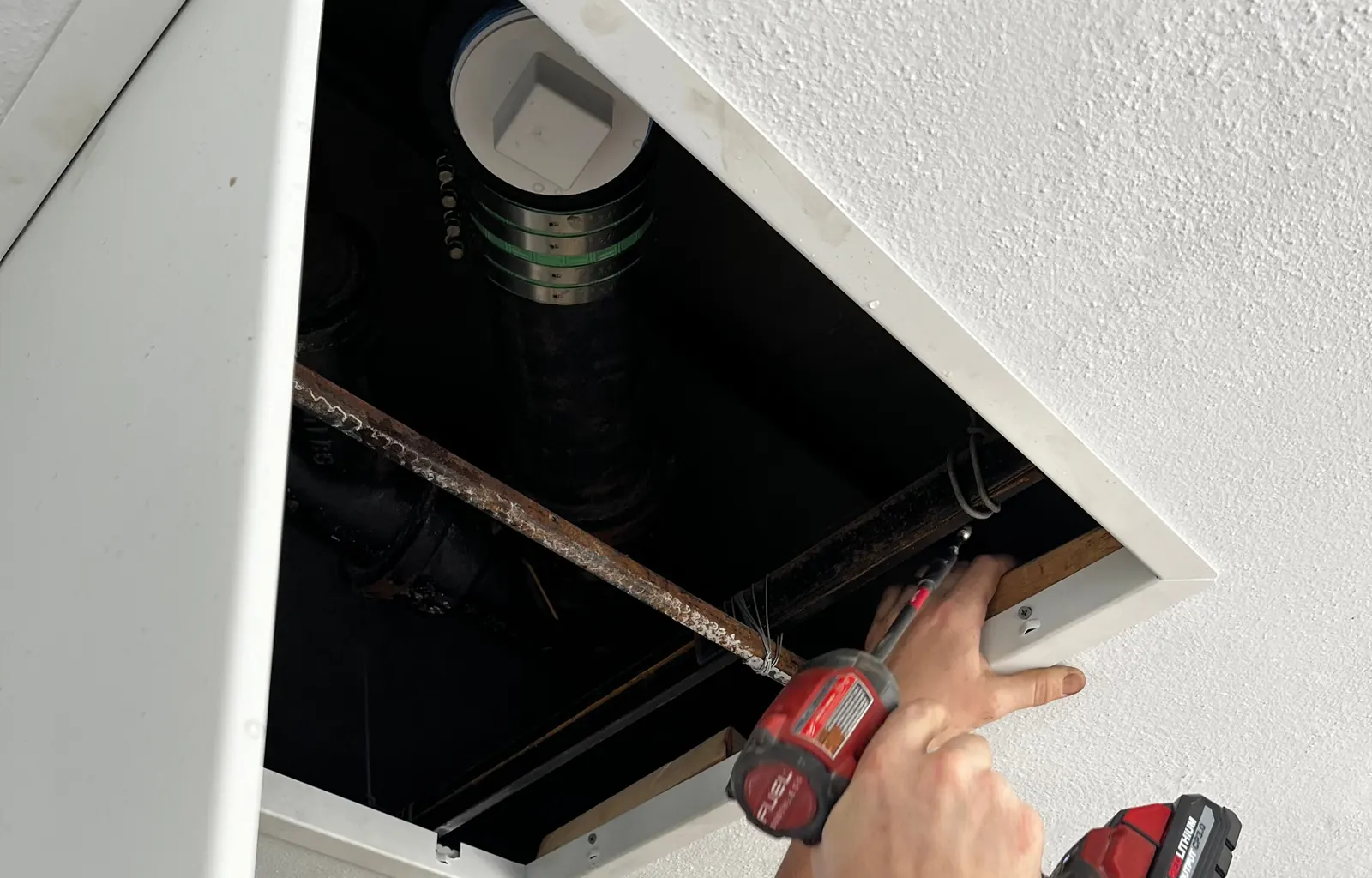
When water comes through the ceiling of a condo, it usually starts in a space you cannot get into. It might be a water heater closet in the unit above, a supply line behind a neighbor’s toilet, or a drain pipe that serves every unit in the stack. You cannot shut it off from your side of the ceiling, and depending on where it started, you may not be the one who pays for the repair.
This time of year, many owners in West Palm Beach and across Palm Beach County are coming back to units that sat closed since spring. A stain that spread over the summer can be the first thing they notice. Florida’s condominium law ties who pays to what failed, why it failed and how soon the association heard about it, so what you do on the first day matters.
Get the Water Stopped First
If water is still dripping, call the owner of the unit above and the building’s management or maintenance line at the same time. Someone has to close a valve on their side, and in many buildings maintenance can shut off one unit or the riser that feeds a whole line of units.
If the owner upstairs is away, tell management that water is reaching your unit. Florida Statute 718.111(5) gives the association an irrevocable right of access to each unit during reasonable hours when it is necessary to prevent damage to the common elements or to another unit. That is the provision that lets maintenance open a door when the owner is out of state.
On your side, switch off the breaker for any light or ceiling fan near the wet spot, move furniture and electronics out of the way, and put a bucket under the drip. If the ceiling is sagging, keep everyone out from under it. Then take photos of the stain and anything that got wet. Photos on your phone keep the date and time, and the association, your insurance company and your plumber will all want them.
Narrow Down Where It Is Coming From
Water moves before it shows up. In a concrete building it can spread across the floor upstairs until it finds a gap around a pipe, then follow that pipe for several feet, so the stain is not always right under the source. When the water appears is often a better clue than where it appears.
| When the water shows up | What it usually points to |
|---|---|
| All the time, day and night | A supply line, valve or water heater upstairs, since those stay under pressure around the clock |
| Only while someone upstairs showers | The shower drain, the waterproof pan under the tile, or the grout and caulk around the tub |
| After a toilet is flushed upstairs | The wax ring that seals that toilet to the drain |
| While the washer or dishwasher runs | The fill hoses, the drain hose or the pipe the washer drains into |
| After heavy rain | A window, balcony door, roof or outside wall |
| On hot days when the air conditioning runs hard | The air handler’s condensate drain or its overflow pan |
Write down which one fits and when you first saw it. A plumber who knows the water only appears after the shower runs upstairs will start in a different place than one who is only told the ceiling is wet.
The Usual Plumbing Sources in a Condo
The water heater. In many Florida condos, each unit has its own electric water heater in a closet, and since floor plans usually stack, that closet often sits right above the same closet in the unit below. When a tank rusts through or the relief valve drips, the water goes into the pan under the heater, and if that pan has no drain line, or the drain is clogged, it spills onto the floor. Our guide on why water heaters leak covers the causes.
Supply lines, hoses and toilets. The flexible lines that feed toilets, sinks, dishwashers, ice makers and washing machines are under pressure all the time. A cracked plastic nut or a split rubber washer hose can put out a lot of water before anyone notices. A toilet that leaks at the base usually has a failed wax ring, and fixing it means pulling the toilet and resetting it on a new ring.
Shared drain stacks. The drains from each unit tie into vertical pipes that run through every floor. Older buildings often have cast iron stacks, which rust from the inside and crack over time. A stack serves more than one unit, and that matters when it is time to decide who pays.
Who Usually Pays Under Florida Law
This part is about insurance and law rather than pipes, so treat it as a general summary. Your building’s declaration, the association’s insurance policy and the facts of the leak decide how it actually comes out.
The association insures the building. Florida Statute 718.111(11)(f) requires the association’s property insurance to cover the condominium property as originally installed. The same paragraph makes each owner responsible for the personal property in the unit, floor, wall and ceiling coverings, electrical fixtures, appliances, water heaters, water filters, cabinets, countertops and window treatments that serve only that unit. Many associations and insurers read that as putting the drywall on the association’s policy and the paint on yours, so one ceiling repair can be split between two policies.
A sudden leak is a common expense. Under 718.111(11)(j), when the parts the association insures are damaged by an insurable event, such as a pipe or tank that suddenly fails, the association repairs them as a common expense, and its deductible is a common expense too.
Negligence shifts the cost. An owner is responsible for the repair costs insurance does not pay when the damage was caused by intentional conduct, negligence, or failure to follow the declaration or the association’s rules by that owner, their family, tenants or guests. That includes damage to other owners’ belongings. If the owner upstairs ignored a drip for weeks, or kept a water heater past the age the association’s rules allow, this is the part of the law that applies.
Two exceptions to ask about. Property policies commonly exclude water that seeped slowly over weeks or months, and without an insurable event the statute defers to the maintenance provisions of your declaration. Under 718.111(11)(k), an association can also vote to opt out of these rules, and your manager can tell you whether yours did.
Your own policy matters as well. Florida Statute 627.714 requires a condo unit owner’s policy to include at least $2,000 of loss assessment coverage, which can help if the association assesses owners after a loss. Call your agent the day you find the damage.
Report It in Writing the Same Day
This is the step owners skip when the neighbor upstairs is friendly and promises to handle it. Under 718.111(11)(j), the association does not have to pay for repairs as a common expense if the owner knew or should have known about the damage and did not report it in time. The cutoff is when the association’s insurance claim for that damage is resolved, or denied because it was filed late. If you just came back after months away, report a stain the day you find it, even if it looks dry.
Send the manager an email with your unit number, the unit you think the water is coming from, the date you found it and your photos. Keep a copy, and forward the plumber’s findings once the source is found.
If the Leak Could Come From Your Unit
Unless you live on the ground floor, your unit sits above someone else’s ceiling. These steps keep it from being the source:
- Know your shutoff. Find the valve that shuts off water to your unit, often in or near the water heater closet, and make sure it turns. If it is stiff or will not close all the way, have it replaced while nothing is leaking.
- Check the water heater. Find out whether your association has a replacement rule, and make sure the tank sits in a pan that drains somewhere. An automatic shutoff valve with a leak sensor, often called a flood stop, closes the water to the heater when the sensor gets wet. We check both on our home plumbing evaluation.
- Replace old supply lines and hoses with braided stainless ones. They cost little compared with one leak into the unit below.
- Shut the water off when you leave for the season. Our summer departure checklist walks through it, and our return checklist covers turning everything back on.
What You Do Not Need Us For
If the water only shows up after heavy rain, it is coming through a window, door, roof or outside wall, so report it to the association and let them sort out whose it is. If it only shows up when the air conditioning runs hard, call your AC company to clear the condensate drain. If the owner upstairs already fixed the leak and your ceiling has stayed dry for several days, what you need is drywall and paint. Drying out wet drywall and checking for mold is work for a water mitigation company.
What a Condo Leak Call With Integrity Includes
Integrity works with condo owners, associations and property managers across West Palm Beach, Palm Beach, Singer Island and the rest of our service area. When you call us about water coming through a condo ceiling, the visit includes:
- Access arranged with the building. We coordinate with the front desk or maintenance staff to reach the unit above, the space where the pipes run, or a ceiling access panel.
- The source traced. When the water is hidden in a wall, a slab or a ceiling, we arrange specialized leak locating through a third party team and explain the scope and the charge before the visit.
- A clear answer on what failed. We show you what we found and tell you whether it is a pipe or fixture that serves one unit, a shared stack, or something other than plumbing, such as the AC drain or a window.
- A written price first. You get a written price before any repair begins, with any drywall, tile and paint work listed separately.
If water is coming through your ceiling right now, call us at 561-310-6435. Our emergency plumbers are available 24/7.
Here are our current planning ranges for the repairs a condo leak can turn up:
| Work | Planning range |
|---|---|
| Third-party leak locating | $510 to $1,420 |
| Accessible pipe or service-connection repair | $290 to $757 |
| Toilet pull and reset | $279 to $369 |
| Toilet component repair or tune-up | $250 to $479 |
| Water heater discharge piping or service valve work | $329 to $902 |
| Integrity-supplied 30 to 50 gallon electric water heater, installed | $1,530 to $4,290 |
Please note: Our price ranges are only rough estimates, and some projects fall outside of these ranges. Leak locating and the repair that follows are priced separately, and drywall, ceiling and paint repairs are not part of the plumbing price. The pricing guides explain what each range covers.
Questions Homeowners Ask
Who pays when water leaks from the condo above me in Florida?
It depends on what failed and why. Under Florida Statute 718.111(11), the association’s insurance covers the building as originally installed, and each owner insures the finishes, appliances and water heater inside their own unit. If the owner upstairs caused the leak through negligence or by breaking the association’s rules, that owner can owe the costs insurance does not pay, including damage to your belongings.
Can the association go into the unit above if the owner is away?
Yes, when it is needed. Florida Statute 718.111(5) gives the association an irrevocable right of access to each unit during reasonable hours for repairs to the common elements, and to prevent damage to the common elements or to another unit.
Who fixes a leaking pipe inside the wall between two units?
Start with what the pipe serves. Florida Statute 718.108 counts installations that furnish utilities to more than one unit as common elements, so a shared stack or riser is usually the association’s. A pipe that serves only one unit is often that owner’s responsibility under the declaration, even inside a wall.
Should I call a plumber or the association first?
If the water is still coming, call management first, since they can shut off water in the building and get into the unit above. Then call a plumber to find the source and price the repair. If the source is a shared pipe, the association may want to send its own plumber, so ask before any work begins.
Final Thoughts
If water is coming through your ceiling, call Integrity Plumbing and Drain at 561-310-6435. We will trace the water back to where it starts, show you what we found, and give you a written price before any repair begins. If what you describe sounds like the AC drain or a window, we will tell you so.
Need plumbing help in West Palm Beach?
Integrity Plumbing & Drain provides same-day service and free estimates.