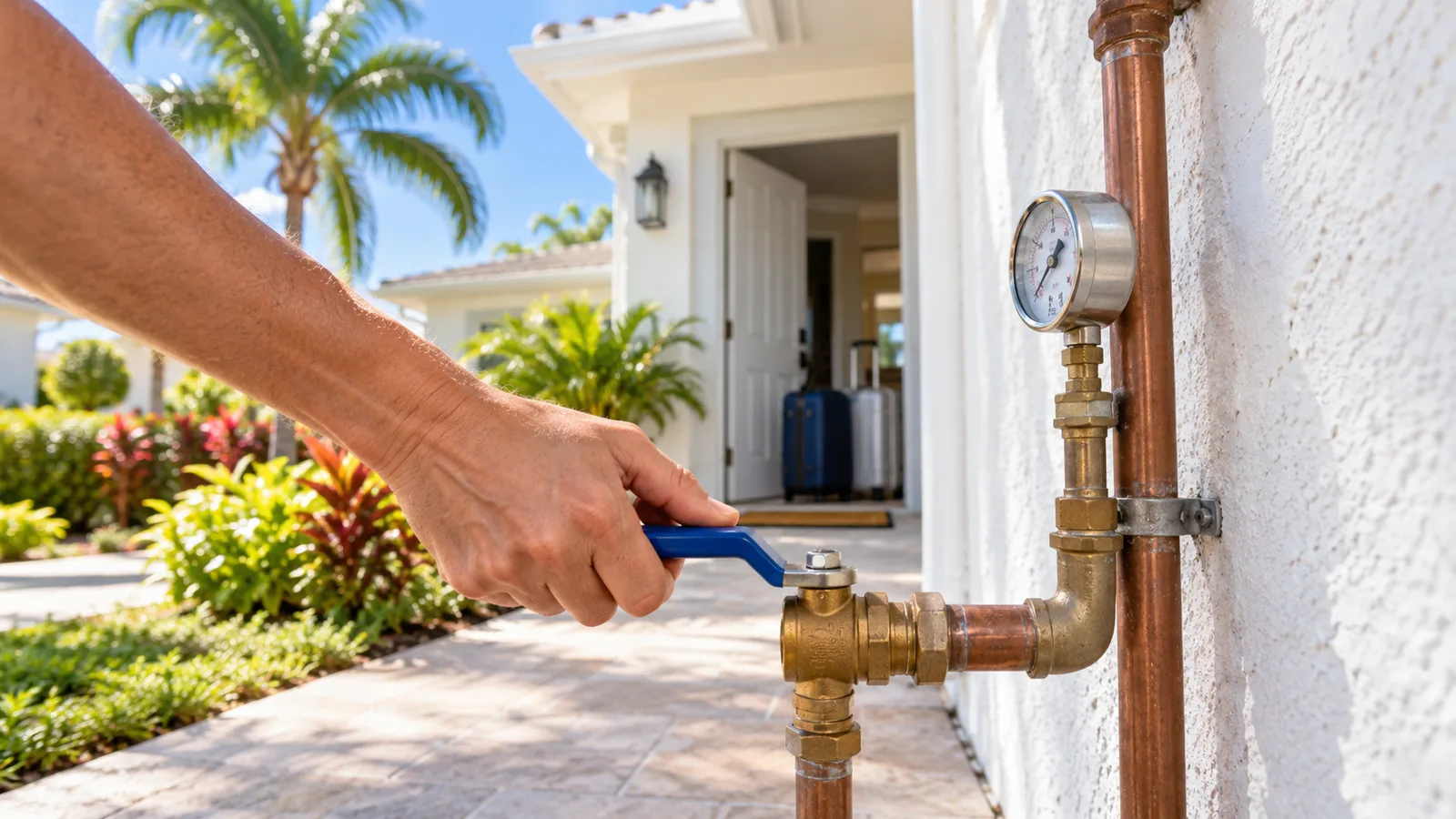
Unless the main was shut off, the plumbing in a house that sits empty all summer stays under pressure the whole time. Nobody is there to hear a toilet refill on its own or see the water meter turning, so a small leak can run for months. If you are coming back to West Palm Beach for the season, the first hour in the house is the easiest time to catch a problem that started while you were gone. Take the steps below in order, because the first one only works before the water is back on.
If you followed our checklist for leaving for the summer, you shut off the main, put the water heater on vacation mode or turned it off, and closed the valves to the washer and the toilets. This is the same list run backwards.
Check the Meter While the House Is Still Off
This step only works now. If you closed the valve at the house and left the city side on, the pipe between the meter and your house stayed under pressure all summer. That pipe runs underground through the yard, so a leak in it never shows up inside.
Find the meter box near the street, lift the lid, and look at the dial. Most meters have a small triangle or star that spins when any water at all is moving. With the house valve still closed, it should sit still. If it moves, the leak is somewhere between the meter and the house. That is a buried line, and it is not something to put off.
If the city turned your service off at the meter, call City of West Palm Beach customer service at (561) 822-1300 to have it turned back on. Palm Beach County Water Utilities customers can call (561) 740-4600.
Turn the Main Back On Slowly
Before you open the main, open the cold tap on one bathtub, ideally the one farthest from where the water comes into the house. A tub spout has no aerator to clog, and it gives the air in the pipes somewhere to go.
Then open the main a quarter turn at a time. A valve opened all at once sends a rush of water and air through empty pipes, and that is when you hear banging and when an old fitting is most likely to let go. Let the tub run until the water flows steady with no spitting, then open the main the rest of the way.
Watch the valve itself for a minute. Older gate valves, the kind with a round handle, can drip at the stem after sitting for months. A small turn of the packing nut just under the handle usually stops it. If the handle spins without opening anything, or the valve will not open or close all the way, leave it alone and call us. The main valve is the one you will need most on the day something breaks.
Flush Out the Water That Sat All Summer
Water that sits in your pipes for months loses the chlorine the utility adds to keep it safe, and the longer it sits, the more it can pick up from the pipes and fittings around it. The EPA’s guidance on restoring water quality in buildings with low or no use calls for flushing both the cold and the hot water at every fixture.
Start with the cold side. Run each faucet, shower and tub until the water runs cold and clear, which usually takes a few minutes. Flush every toilet twice, and run the outdoor spigots as well. If a faucet sputters or slows to a trickle afterward, unscrew the aerator at the tip and rinse out the grit that came loose.
If your refrigerator has an ice maker, throw out the first few batches of ice, and replace the water filter if it was due before you left.
Bring the Water Heater Back the Right Way
On an electric tank, make sure the tank is full of water before the power goes back on. Open a hot water faucet and wait until it runs steady with no air. Only then flip the breaker or take the heater off vacation mode. An electric element that fires in open air burns out in seconds, and then you are without hot water until it is replaced.
On a gas heater, follow the lighting instructions on the label on the tank. If you smell gas in the air near the heater, do not light anything. Leave the house and call your gas company from outside.
Set the thermostat to 120 degrees, which is the setting the Consumer Product Safety Commission recommends to prevent scalds. Once the tank is hot, run the hot side of every faucet and shower for a few minutes to flush that side too.
Then look at the tank one more time. Water in the drain pan, rust at the base, or a drip from the pipe on the side of the tank, which is the relief valve discharge line, all mean the heater needs a closer look. If the tank is ten years old or more and showing any of those signs, it is better to replace it on your own schedule than after it fails. Our water heater repair page covers what can be fixed and what cannot.
A rotten egg smell that comes only from the hot water is a separate problem. It happens when bacteria in the tank react with the metal rod inside it, called the anode rod, and it is most likely in a tank that sat for months without use. Flushing the tank often clears it. If the smell keeps coming back, the anode rod can be swapped for a type that does not react the same way.
Refill Every Drain and Check the Toilets
Every sink, tub, shower and floor drain has a U-shaped trap that holds a little water to keep sewer gas out of the house. Over a Florida summer that water evaporates. Run water down every drain for about thirty seconds, including the guest bath nobody uses, and the sewer smell should clear within the hour.
Turn the toilet supply valves back on one at a time and check each one for a drip at the stem. Then listen. A rubber flapper that sat dry for months can stiffen and stop sealing, and the tank will refill on its own every few minutes. The food coloring test in our guide to high water bills will confirm it, and a flapper is an inexpensive part.
Turn the washer valves back on and look at the fill hoses. If they are the black rubber kind, check for bulges or cracks near the ends. If they are getting old, replace them with braided stainless hoses.
Read the Meter One More Time
Once everything is back on, the traps are full and nothing is running, go back out to the meter. Write down the reading, wait ten minutes without using any water, and read it again. It is the same ten minute test from that high water bill guide.
If the reading moved, close the valve behind each toilet and test again. If it still moves with the toilets off, the water is leaving through a pipe you cannot see, under the slab, inside a wall or out in the yard. That is the point where professional leak detection makes sense.
What You Do Not Need Us For
Most of what you notice in the first hour is normal, and you should not pay a plumber for it.
Faucets that spit and sputter are pushing out air, and they settle down within a few minutes. Water that comes out cloudy and clears from the bottom of the glass up is also air. Brown or rusty water at first that runs clear after a few minutes is sediment the flush stirred up. A sewer smell that goes away once you run water in the drains was a dry trap. A stiff valve that frees up and stops dripping after a small turn of the packing nut is fine.
When to Call Integrity
Call us if the meter moves with everything off, if you notice a water stain or soft drywall, if the main or a fixture valve will not open, close or stop dripping, if the water heater leaks from the tank or will not heat within a couple of hours, or if a sewer smell comes back after you refilled the traps. A main drain that gurgles or backs up after a summer of storms is worth a look too, since roots often find their way into the line during the rainy season, which we cover in our post on tree roots in sewer lines.
Here are our current planning ranges for the repairs this checklist can turn up:
| Work | Planning range |
|---|---|
| Third-party leak locating | $510 to $1,420 |
| Accessible pipe or service-connection repair | $290 to $757 |
| Slab or buried water line repair | $1,422 to $3,054 |
| Toilet component repair or tune-up | $250 to $479 |
| Water heater element or thermostat repair | $250 to $545 |
| Integrity-supplied 30 to 50 gallon electric water heater, installed | $1,530 to $4,290 |
Please note: Our price ranges are only rough estimates, and some projects fall outside of these ranges. Leak locating and the repair that follows are priced separately. The pricing guides explain what each range covers.
Questions Homeowners Ask
How long should I run the water after being away for months?
Run each cold faucet until the water is cold and clear, which usually takes a few minutes, then do the same with the hot side once the water heater is back up to temperature. Flush every toilet and throw out the first few batches of ice.
Why does my house smell like sewer when I get back?
The water in your drain traps evaporated while you were gone, which lets sewer gas come up through the drains. Run water in every drain for about thirty seconds. If the smell does not clear within an hour or two, have a plumber check the drain lines and the vent.
Should I turn the water heater on before or after the water?
After. Turn the water on, open a hot faucet and wait until it runs steady with no air, then turn the power or gas back on. An electric element that heats in an empty tank burns out within seconds.
Why does my hot water smell like rotten eggs after a long trip?
Bacteria in the tank react with the anode rod, and the smell builds up when the water sits for a long time. Flushing the tank usually clears it. If it keeps coming back, ask about replacing the anode rod. If you smell rotten eggs in the air near a gas appliance rather than in the hot water, leave the house and call your gas company.
Final Thoughts
If the meter will not sit still or you spot a leak after the water is back on, call Integrity Plumbing and Drain at 561-310-6435. We will find where the water is going, show you what we found, and give you a written price before any repair begins. If what you describe sounds like air in the lines or a dry trap, we will tell you so.
Need plumbing help in West Palm Beach?
Integrity Plumbing & Drain provides same-day service and free estimates.