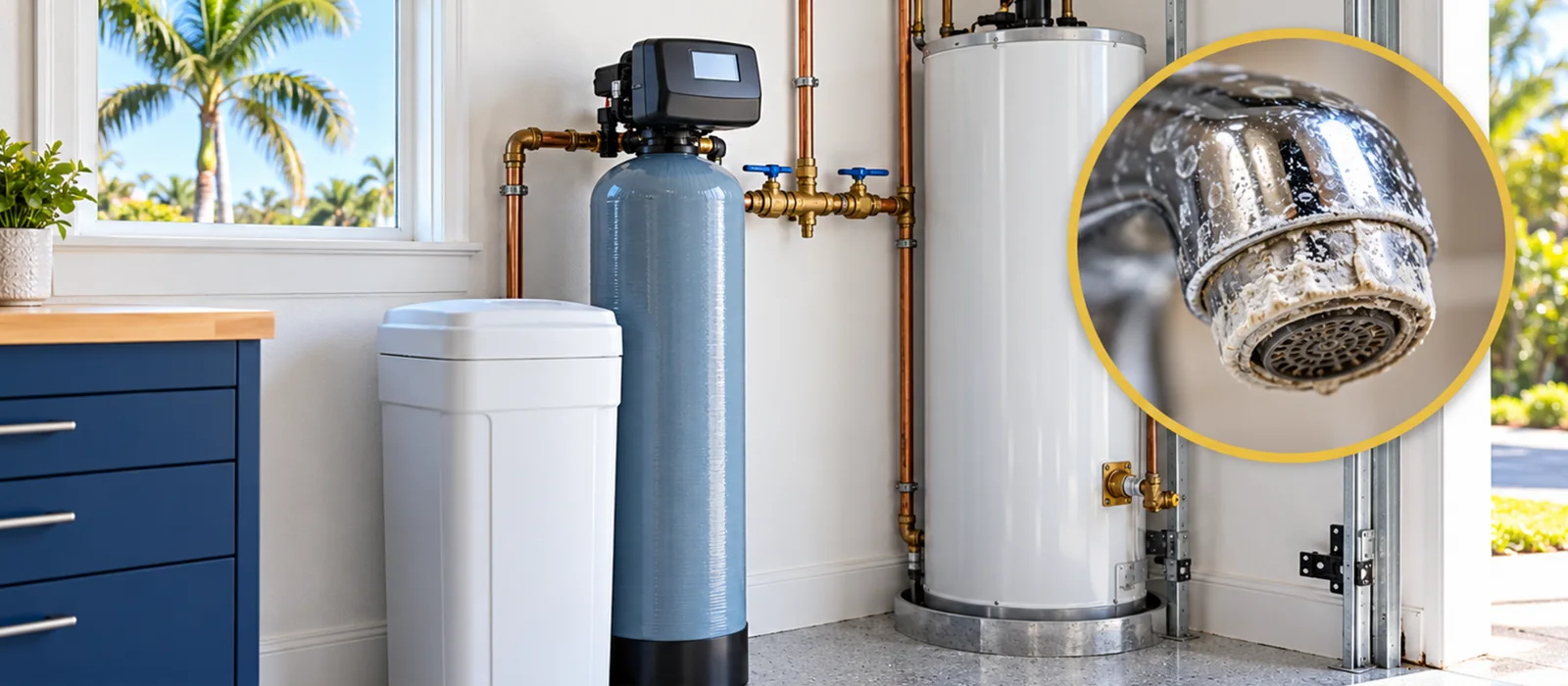
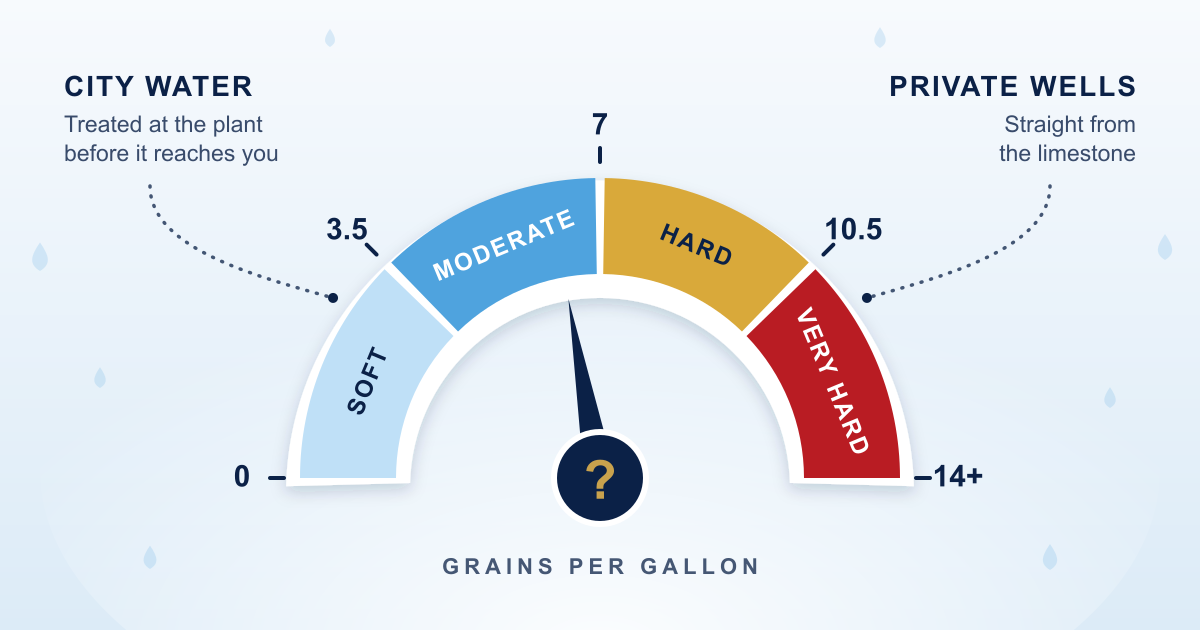
You will hear it said that the water in Palm Beach County is some of the hardest in Florida. That is true of the raw groundwater, which sits in limestone. It is only part of the picture for a home on city water, because most of that water is treated, and usually softened, at the plant before it ever reaches your faucet. A home on a private well gets none of that treatment.
What matters for your house is how hard the water is at your own kitchen sink, and what it is doing to the appliances that heat it. Finding that out takes one test. It is worth doing before anyone quotes you a system, because the answer decides whether a softener is money well spent or money you did not need to spend.
Where Your Water Comes From
The City of West Palm Beach does not pump its water out of the ground. It starts as rainfall stored in Grassy Waters Preserve and flows by canal to Lake Mangonia and Clear Lake, where the city draws and treats it. That makes it surface water, which only about one in ten Florida cities use. The city’s water quality reports describe filtration and UV disinfection at the treatment plant, and the 2023 report lists lime softening among the plant’s treatment steps.
Palm Beach County Water Utilities pumps groundwater instead, from the Biscayne Aquifer about 150 feet down in the east and from the deeper Floridan Aquifer in the west. Its water quality report lists lime softening, nanofiltration and reverse osmosis among the treatment processes at its plants.
Other cities soften at the plant as well, and some publish the result. The City of Boca Raton lists its water at 3.8 to 4.7 grains per gallon, which sits in the moderately hard range.
A home on a private well is a different situation. Well water comes straight out of the limestone with no plant in between, it usually tests well above city water, and it often brings iron, which leaves orange stains in tubs and toilets, or sulfur, which smells like rotten eggs on the hot side.
How to Read a Hardness Number
Hardness is measured in grains per gallon (gpg) or in milligrams per liter (mg/L), which is the same thing as parts per million. One grain per gallon is about 17.1 mg/L. The U.S. Geological Survey sorts water hardness into four bands:
| Grains per gallon | Milligrams per liter | What it means |
|---|---|---|
| Under 3.5 | Under 61 | Soft |
| 3.5 to 7 | 61 to 120 | Moderately hard |
| 7 to 10.5 | 121 to 180 | Hard |
| Over 10.5 | Over 180 | Very hard |
There are three ways to get your number. Your utility publishes a water quality report every year, although not every report lists hardness, so you may need to call and ask. A test strip kit from the hardware store gives a quick reading if you run the cold kitchen tap for a minute first and dip the strip in a glass. Or we can test it at your sink as part of a free in-home water test, which also checks chlorine, iron, pH and total dissolved solids.
The soap and bottle test from our earlier guide on West Palm Beach hard water will tell you whether your water leans hard or soft. It will not give you a number, and the number is what decides whether a softener makes sense.
Where Hard Water Does the Damage
Calcium carbonate, the main mineral in hard water, becomes less soluble as water gets hotter. That is why scale builds fastest wherever water is heated or left to dry, and why even moderately hard water causes trouble in a few predictable places.
Tank water heaters. The minerals settle to the bottom of the tank as sediment. That is the popping and rumbling you hear while the tank heats, and over the years the sediment takes up room that used to hold hot water. Flushing the tank once a year, which we cover in our guide to annual water heater flushes, clears most of it out.
Tankless water heaters. Scale coats the narrow passages of the heat exchanger. The first sign is usually water temperature that swings up and down in the shower, followed by error codes. Most tankless manuals call for periodic descaling, and damage caused by scale is commonly excluded from warranty coverage, so check the manual for your model and the hardness limit it lists.
Dishwashers, ice makers and coffee makers. You see it as cloudy glasses, a white film on dishes, and fill valves that slow down. Many dishwashers have a water hardness setting, and setting it to your actual number helps.
Shower glass and fixtures. Every drop that dries on the glass leaves its minerals behind, which is why spots appear even with moderately hard water. Over time the same minerals stiffen faucet cartridges and clog aerators and shower heads. In the drain, they react with bar soap to form the sticky scum behind most recurring shower clogs.
None of that is an emergency on its own. It is wear that adds up on every appliance in the house that heats or holds water, and it is the reason the number is worth knowing.
When a Softener Is Worth It
A softener does one job. It removes calcium and magnesium from the water before it reaches the rest of the house. Whether that job is worth paying for depends on your number and on what is actually bothering you.
It is usually worth it if your home is on a private well, where the softener is normally one part of a system that also deals with iron and sulfur. It is usually worth it if your water tests at 7 grains per gallon or higher at the tap. It deserves a serious look if you have a tankless water heater and scale keeps causing service calls or frequent descaling. And it is a fair choice if you simply want spot-free glass and water that feels softer, as long as you know that is a comfort purchase and you are buying it for that reason.
When It Is Not
There are a few situations where we would tell you to keep your money.
If you are on city water, it tests in the moderate range, and what really bothers you is the taste or smell of chlorine, a softener will not change that. A carbon filter will, and it costs less. If you mainly want better drinking water, an under-sink reverse osmosis system is built for that job. If your only problem is one sputtering faucet, soak the aerator in white vinegar overnight before you call anyone.
Salt-free conditioners are often sold as the alternative to a softener. They do not remove the minerals. What they do is change how the minerals behave so that less scale sticks inside pipes and appliances, which also means they will not stop spots on glass. Ask which one you are being quoted before you sign anything.
If your test does not justify a softener, we will tell you that. It is the same thing we tell every homeowner who asks us about a water filtration system.
What a Softener Involves and What It Costs
A conventional softener is a tank of resin beads that trade the calcium and magnesium in your water for sodium, or for potassium if you prefer. A second tank holds the salt. Every so often the system rinses the beads with salt water to recharge them. It needs a spot near where water enters the house, a drain line, and usually a power outlet. A bypass valve lets you take it out of the loop for service.
Upkeep is mostly adding salt as the level drops. The resin typically lasts 10 to 15 years, and the control valve is the part most likely to need a repair along the way.
Here are our current planning ranges from the water filtration and softener price guide:
| Option | Planning range |
|---|---|
| Integrity-supplied residential softener, installed | $1,960 to $3,506 |
| Softener and filtration combination | $4,437 to $8,910 |
| Installing a softener or under-sink RO system you already bought | $450 to $990 |
| Softener control valve repair | $506 to $619 |
Please note: Our price ranges are only rough estimates, and some projects fall outside of these ranges. Salt, replacement filters and future maintenance are separate unless your agreement says otherwise.
Questions Homeowners Ask
Is West Palm Beach water hard?
The groundwater under Palm Beach County is hard because it moves through limestone. City water in West Palm Beach comes from rain-fed lakes instead of limestone wells, and it is treated at the plant before delivery, so what reaches your tap is softer than raw groundwater. Private wells are not treated and usually test much harder. A test at your own tap is the only way to know your number.
Do I need a water softener if I have a tankless water heater?
Not always, but you should know your hardness. Scale is the main maintenance issue for tankless units. If your water tests hard, or your heater needs frequent descaling, a softener or a scale prevention system protects the heat exchanger. Check your model’s manual for its hardness limit.
Will a water softener fix low water pressure?
Usually not. A softener stops new scale from forming, but it does not clean out what has already built up, and low pressure has several possible causes. Our guide to low water pressure walks through them. A softener that is too small for the house can actually lower pressure, which is why sizing matters.
How long does a water softener last?
The resin inside a softener typically lasts 10 to 15 years with normal upkeep. The control valve may need repair during that time, and keeping salt in the brine tank is the main job for the homeowner.
Is softened water safe to drink?
Softened water is generally fine for most people. It does contain a small amount of added sodium, so anyone on a sodium-restricted diet should talk with their doctor. Common solutions are using potassium chloride in place of salt, or adding a reverse osmosis faucet for drinking and cooking water.
Final Thoughts
If you want a real reading instead of a guess, call Integrity Plumbing and Drain at 561-310-6435 and ask for a free in-home water test. We test at your kitchen sink, show you the numbers, explain what they mean for your water heater and fixtures, and tell you plainly whether a softener is worth it for your house. If it is not, you will hear that from us too.
Need plumbing help in West Palm Beach?
Integrity Plumbing & Drain provides same-day service and free estimates.