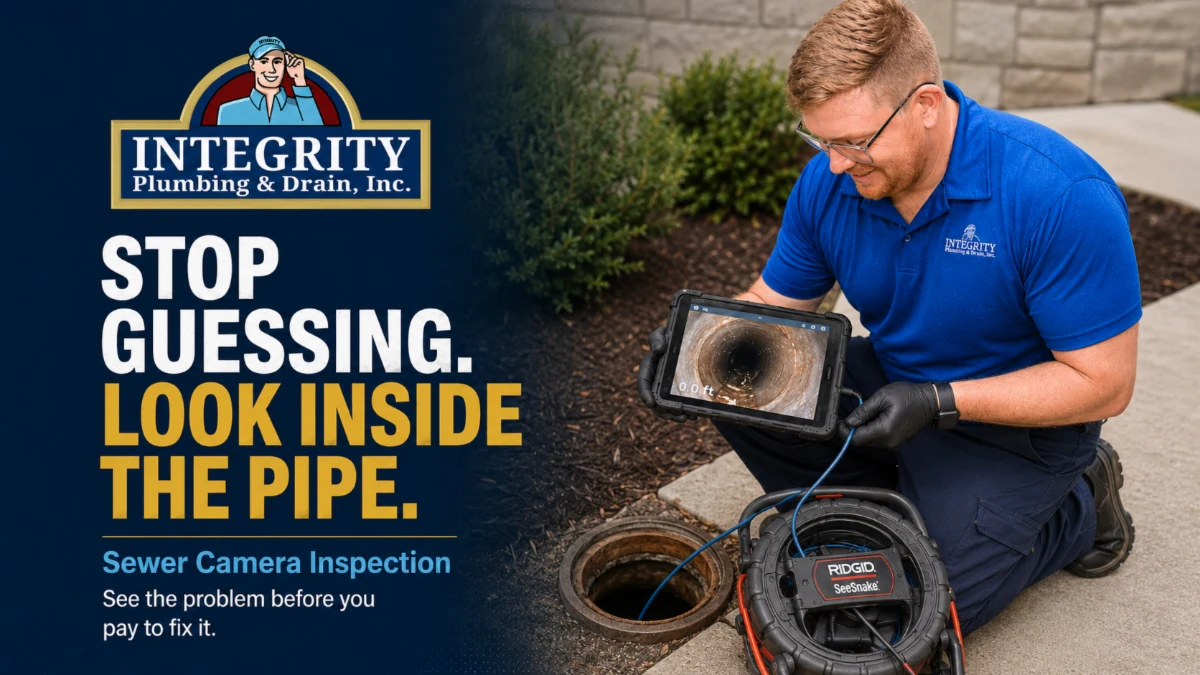
The Problem With Guessing
Most plumbing diagnoses used to be educated guesses. A line backs up, someone runs a cable through it, the water goes down, and everyone moves on without knowing what caused it. That works fine when the answer is a hairball. It works badly when the real answer is a cracked pipe under your driveway, because the same clog comes back in six weeks and you pay for the same visit again.
A sewer camera ends the guessing. It is the difference between a plumber telling you what he thinks is wrong and a plumber showing you what is wrong on a screen while you stand there watching. For a homeowner about to spend real money, that distinction is everything.
Here is what the camera actually shows, when it is worth running one, and why you should never approve a big repair you have not seen with your own eyes.
What a Sewer Camera Actually Is
It is a waterproof, self lighting camera head on a long flexible push rod, usually a couple hundred feet of it, fed into your line through a cleanout. The head sends live video back to a monitor, and a transmitter inside it lets us locate its exact position from above ground, which means we can mark the spot on your lawn where a problem sits and tell you how deep it is.
That locating piece matters more than people expect. Finding a break is useful. Knowing it is nineteen feet out, four feet down, under the grass and not under the driveway is what turns a scary repair into a manageable one.
The Six Things We Are Looking For
Roots. The most common finding in older West Palm Beach neighborhoods. Roots find the smallest gap at a joint, work in as fine hairs, then thicken into a mass that catches everything flowing past. On camera they look like a beard growing into the pipe. We covered how they get in and what to do about them in our guide to tree roots in sewer lines.
Grease and scale buildup. A narrowed pipe still drains, so homeowners assume it is fine. The camera shows how much room is actually left. Seeing a six inch line reduced to two inches of open channel explains years of slow drains in about four seconds.
Bellies. A belly is a low spot where the pipe has sagged and no longer runs downhill, so water and solids sit in it instead of flowing through. Our sandy soil and high water table make these common here. The camera reveals them as standing water that never clears, and they are the single most misdiagnosed problem in drain work, because cabling a belly does nothing at all.
Cracks, breaks, and offset joints. Exactly what they sound like. An offset joint is where two sections have shifted out of alignment, leaving a lip that catches debris and lets soil in. Left alone these get worse, and the warning signs of a failing line usually show up at the fixtures long before anyone looks inside.
Channeling in cast iron. If your home predates the mid 1970s, the drains are probably cast iron, and cast iron rots from the bottom up. The camera shows the floor of the pipe eaten away into a trough while the top still looks solid. This is the finding that most often changes a homeowner’s plans, and it ties directly into what we wrote about the pipes insurance companies hate.
Foreign objects and collapses. Toys, wipes, chunks of a previous repair, and the occasional section that has simply given up and caved in.
Why It Matters More Here
South Florida is hard on buried pipe in ways that other parts of the country are not.
Sandy soil shifts and settles, which is how bellies and offset joints form. The water table sits high, so a cracked line does not just leak out, groundwater also pushes in, carrying sand that builds up and accelerates the wear. Root systems here grow year round instead of going dormant for a season. And a large share of the housing stock in West Palm Beach and the surrounding neighborhoods was built during the cast iron era, which means a lot of drain lines are running past the end of their intended service life right now.
None of that is visible from inside your house. All of it is visible on camera.
When a Camera Inspection Is Worth Paying For
Not every slow drain needs one. These situations do:
- You are buying a home. A standard home inspection does not include the sewer line, and replacing one is a five figure surprise. On any home more than thirty years old this is the cheapest insurance in the entire transaction.
- The same drain keeps backing up. Once is a clog. Three times in a year is a condition, and cabling it again is just renting a solution. If you are stuck in that cycle with one fixture, our post on recurring shower drain clogs covers the branch line version of the same story.
- More than one fixture is affected. Multiple slow drains, or gurgling when you run water elsewhere, points at the main line rather than any single fixture.
- Before a remodel or a repipe. Opening walls and floors is the cheapest time to fix anything under them. Finding out afterward is the most expensive.
- You smell sewage in the yard or see a green stripe in the grass. A line that is leaking underground fertilizes the lawn above it. That patch is a map.
- A plumber quoted you a big repair. Get it on camera before you sign. A reputable company will welcome it.
What Actually Happens During the Appointment
We locate or access a cleanout, feed the camera in, and run the line while you watch the monitor with us. We narrate what you are seeing, stop at anything worth a closer look, and use the locator to mark the position and depth of any problem in your yard.
Most inspections take under an hour. Nothing is dug up and nothing is opened. If the line is too blocked to pass the camera, we clear it first, because a camera cannot see through a plug of grease and roots. That is a normal sequence and not an upsell, though you should expect to be told about it before the work happens rather than after.
At the end you get the findings in plain language: what is in there, how serious it is, where it sits, and what your options are with real pricing attached. Sometimes the honest answer is that your line is in good shape and you should do nothing. That is a legitimate result and worth knowing.
Ask for the Footage
You should get a copy of the video, or at minimum stills of anything used to justify a repair. Any company that inspects your line and hands you a verdict without showing you the screen is asking you to spend thousands of dollars on faith.
The findings should support the repair being proposed, whether the problem is in a drain or a water supply line. For hidden water leaks, Integrity arranges specialized third-party locating, reviews the findings, and provides a separate written plumbing repair estimate. Read how locating and repair work together for the distinction between those scopes.
A few red flags worth naming. Be cautious if someone will not let you watch the monitor, if the footage they show you has no identifying detail that ties it to your house, or if a full line replacement gets recommended without you ever seeing the section that supposedly failed. A second opinion costs a fraction of an unnecessary sewer line repair.
When to Call a Professional
Call when:
- You are under contract on an older home and the inspection period is still open.
- A drain has backed up more than twice in the past year.
- Multiple fixtures are slow or you hear gurgling in one when another runs.
- You are planning a remodel that will cover or cut into a slab.
- Someone quoted you a major sewer repair and you want to see the evidence first.
We will run the line, show you the screen while we do it, mark anything we find, and give you the options in writing. If nothing is wrong, we will tell you that and you will have documentation saying so.
Final Thoughts
A sewer camera does not fix anything. What it does is remove the part of plumbing that costs homeowners the most money, which is deciding what to do without knowing what is actually there. Every expensive surprise we get called out to started as a condition somebody could have seen years earlier for a fraction of the cost.
At Integrity Plumbing and Drain, we would rather show you the inside of your pipe than ask you to take our word for it. If you are buying an older West Palm Beach home, fighting the same backup over and over, or staring at a repair quote you are not sure about, call us at 561-310-6435 and let us put a camera in the line first.
Need plumbing help in West Palm Beach?
Integrity Plumbing & Drain provides same-day service and free estimates.