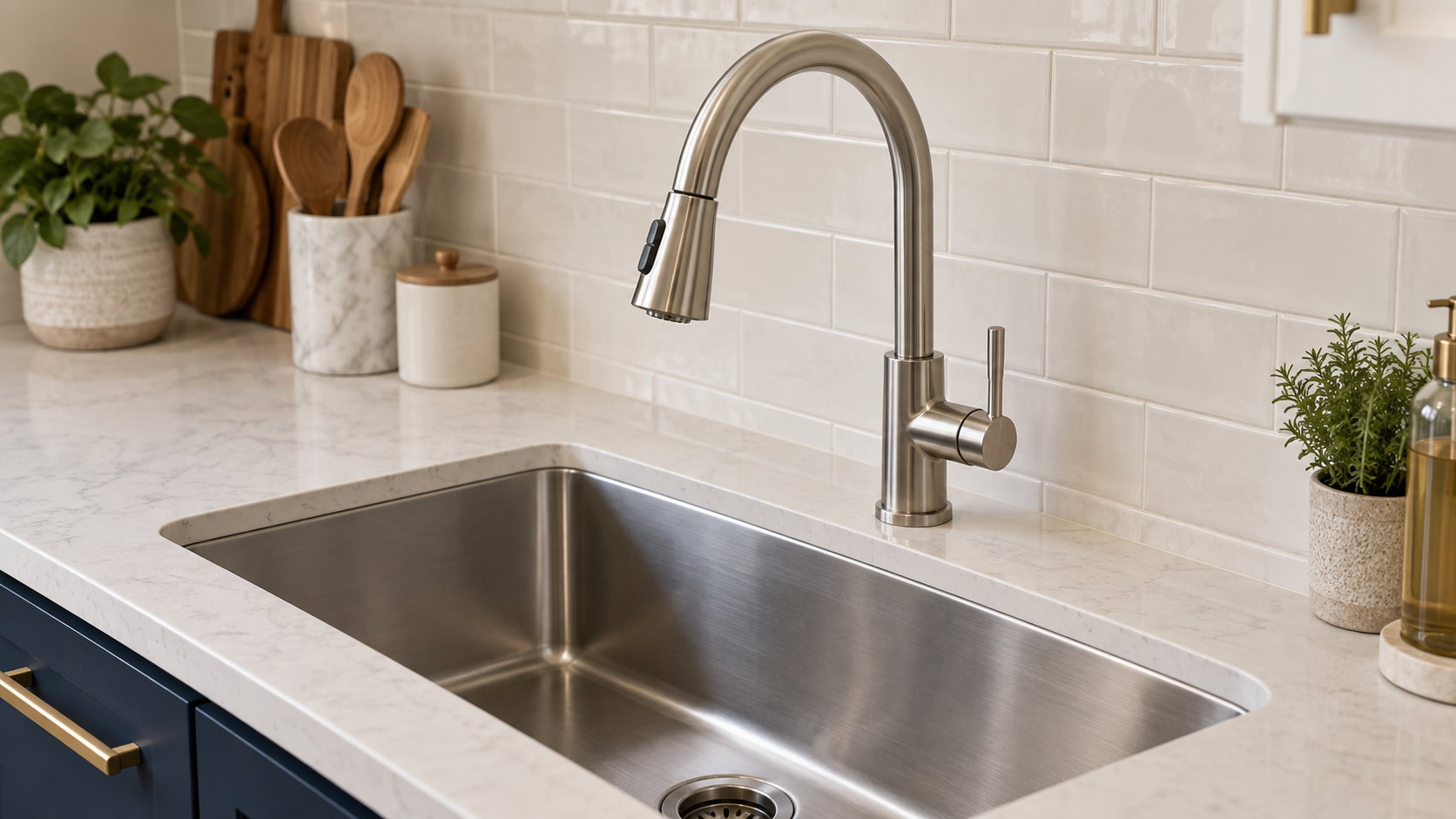
A new kitchen faucet can be a satisfying upgrade. You finally get a sprayer that reaches the corners, a handle that feels comfortable, or a finish you actually like. Then the box arrives, and an overlooked detail gets in the way: the base does not cover the old holes, the handle hits the backsplash, or the hose catches beneath the sink.
Before choosing a model, spend a few minutes looking at the sink you already have. These checks can help West Palm Beach homeowners narrow the options and make the installation conversation easier.
Start With the Mounting Holes
Count the openings used by the existing faucet, separate handles, side sprayer, and soap dispenser. A wide base can hide unused holes, so what you see above the sink may not tell the whole story. A photo from inside the cabinet can help if the area is safely accessible. You do not need to disconnect anything just to begin shopping.
Some faucets use one mounting hole; others need several. A compatible deck plate, also called an escutcheon, can cover additional openings. Delta’s kitchen faucet guide explains how mounting holes and deck plates work together.
Check the exact model’s requirements and whether the plate is included or sold separately. Decide which accessories you want to keep. If the openings do not match, ask about the options before purchasing or planning changes to the sink or countertop.
Look Beyond the Product Photo
Find the manufacturer’s specification sheet for the exact model number. It should answer practical questions that a lifestyle photo cannot: required hole size, mounting arrangement, maximum deck thickness, and the space the faucet occupies.
Deck thickness is the thickness of the surface the faucet mounts through. Do not assume that a model designed for one installation will clamp securely through every sink or countertop. If you cannot determine the mounting thickness, have the installer check it before ordering. Any extension hardware must be suitable for that particular faucet.
Save the specification sheet with your shopping notes. Two faucets that look nearly identical can have different installation requirements.
Match the Spout to How You Use the Sink
Think about the largest pot you wash, the pitcher you fill, and whether you use one basin or two. A taller faucet may provide useful space, but height alone does not tell you where the water will land.
Spout reach describes how far the water stream extends horizontally from the faucet’s base. Kohler’s guide to spout height and reach shows why these are separate measurements.
Compare the drawing with your sink. Will the stream reach a comfortable working area? Can the spout swing where you need it? Would a spray head that pulls down or out make rinsing easier? If possible, try the handle and spray controls on a display model. The best choice should suit your hands and your normal kitchen tasks.
Check What Is Behind and Above It
Picture the handle moving through its full range, including the position for hot water. A faucet can fit the mounting hole and still run into the backsplash when you use it.
Check nearby window handles, opening windows, shelves, and cabinets too. A tall arch should not prevent something else from opening. Use the model’s drawing and installation instructions to confirm clearance instead of relying on a universal measurement.
Take a side photo of the current setup. It often shows these obstacles more clearly than a photo taken straight on.
Give the Cabinet a Look Too
A faucet with a retractable sprayer needs room for its hose to move beneath the sink. Drain pipes, the garbage disposal, a filter system, and stored items can occupy that same space. Ask the installer to check the hose path and access to the mounting hardware.
The water connections matter as well. Confirm whether supply lines are included, whether they suit the existing connections, and whether the shutoff valves need attention. Mention visible corrosion or dripping. Do not force a stiff valve to test it before the appointment.
For a touchless model, check its power arrangement. Some use batteries; others offer an adapter. Allow for the control unit and future access to the battery compartment. This Moen specification sheet is an example of the model details worth checking, including deck thickness, supply connections, and power options. It is not a recommendation that this faucet fits every kitchen. If electrical work is needed, include that in the plan before ordering.
Choose a Finish You Can Live With
Look at finish samples alongside your sink and cabinet hardware. Then read the manufacturer’s care instructions and warranty for that finish. Choose something you are comfortable maintaining.
Before buying, also find the model’s parts diagram and support information. Knowing how to identify a replacement cartridge, spray head, or hose will help if service is needed later. Keep the model number, receipt, and installation paperwork together.
Bring These Details to the Installation Conversation
Have the product link and exact model number ready, along with photos of the sink, the space behind the faucet, and the cabinet below. Note the accessories you want to keep and anything that bothers you about the current setup.
Integrity Plumbing & Drain can help check the fit and explain what the replacement involves. Visit our faucet repair and installation page to start planning an upgrade that works for your kitchen.